

When to use a draft
Drafts work well whenever you want to try something without changing the version everyone else is working on. For example:- Test a redesign. Try new colors, fonts, or a different layout in a draft, and compare it with your current design before you commit to it.
- Find the words that work. Write different headlines, product descriptions, or calls to action in separate drafts, and keep the version that reads best.
- Try new visuals and motion. See how different photos, illustrations, or video change the feel of a page, or test scroll animations, a carousel, or a sticky navigation bar.
- Build a feature that needs new data. Ask for a new table or column in a draft. Lovable prepares the change and adds it to your project’s database when you accept the draft. See Add database tables and columns from a draft.
- Prepare changes for later. Build a sale banner or a seasonal page in a draft today, and accept it when you want to add it to your project.
- Hand changes to someone else. Let a teammate or client work in a draft, then review the changes and accept them when they’re ready.
How drafts work
You create a draft from your project’s main version, make changes in the draft, then accept it to keep those changes or delete it to discard them. You’ll see six terms as you work with drafts: Main, Draft, Update, Accept, Delete, and Publish. The table below explains each one using the same example: a bakery website where you want to try a new homepage design without changing the homepage you already have.Creating, updating, accepting, and deleting a draft don’t use credits. You use credits only for the messages you send in a draft, and a message costs the same in a draft as in the main version of your project.
For readers who know version control
For readers who know version control
If you’ve used version control, drafts map to familiar concepts:
- A draft is a branch forked from your project’s history, with its own project chat.
- Update rebases the draft onto the latest version of your project. If changes overlap, Lovable resolves the conflicts by reworking the draft’s edits.
- Accept is a fast-forward merge. Your project’s history stays linear, and the draft’s edits are added as a named group.
- Delete discards the branch.
Create your first draft
Follow these steps to create a draft, make changes, compare it with your project, and decide whether to keep it.1
Open the draft switcher
In the editor, click your project’s name at the top to open the draft switcher, where you find the project’s drafts. The top row shows your project’s name. Select the Project settings button beside it to open your project settings.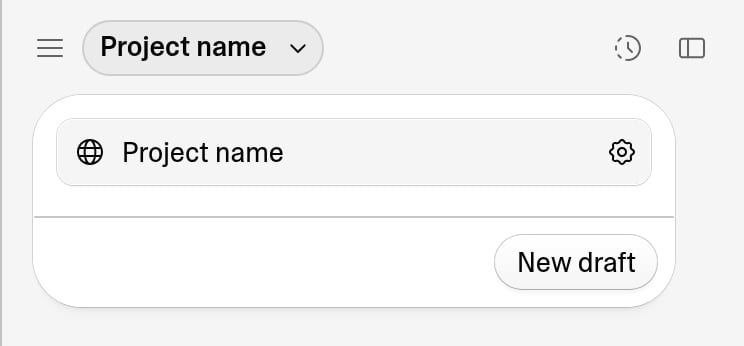
2
Create a draft
Click New draft. The new draft opens immediately as a copy of the main version of your project. It starts with the name Draft 1, and Lovable renames it based on your first prompt. To choose your own name, hover over the draft in the switcher, open its ⋮ menu, and select Rename. A name can be up to 80 characters.
3
Build in the draft
Work with Lovable in the draft’s chat as you always do. Every edit stays in the draft, and the preview shows the draft’s version of your app.
4
Compare with your project
Use the draft switcher to move between the main version of your project and your drafts.Your project’s name always shows which version you’re viewing: the name on its own for the main version, or the name with the draft’s name beside it while you’re in a draft. The project chat and preview change to match it. To return to the main version, select the top row of the switcher, which shows your project’s name.You can create as many drafts as you like and use each one to try a different idea.
5
Accept the draft, or delete it
When you want to keep a draft’s changes, select Accept. You’ll find it in several places while you’re in a draft: in the top right of the editor where Publish usually is, at the bottom of the draft switcher, and in the draft’s ⋮ menu. In the switcher you can also drag the draft onto the top row, which shows your project’s name, and in the draft’s chat you can ask Lovable to accept it.You can accept even when your project has newer edits that the draft doesn’t have yet. Lovable updates the draft first, then accepts it. To update on its own instead, use the chevron next to the switcher’s Accept button, or the draft’s ⋮ menu.Before accepting, Lovable shows you a one-line summary of what the draft changes, followed by the draft’s edits. Confirming adds them to your project’s unpublished changes and returns you to the main version of your project. The accepted draft moves to your project’s history. Accepting doesn’t use credits.Lovable keeps that summary. It appears labeled Draft summary on the accepted change in your project’s chat, and on that change in version history.If you don’t want to keep the draft, delete it instead.
Accepting does not publish the changes, and a draft has no Publish button of its own. Publish your project from the main version when you want the changes to go live.
Status indicators
When you have several drafts, the switcher shows the status of each one: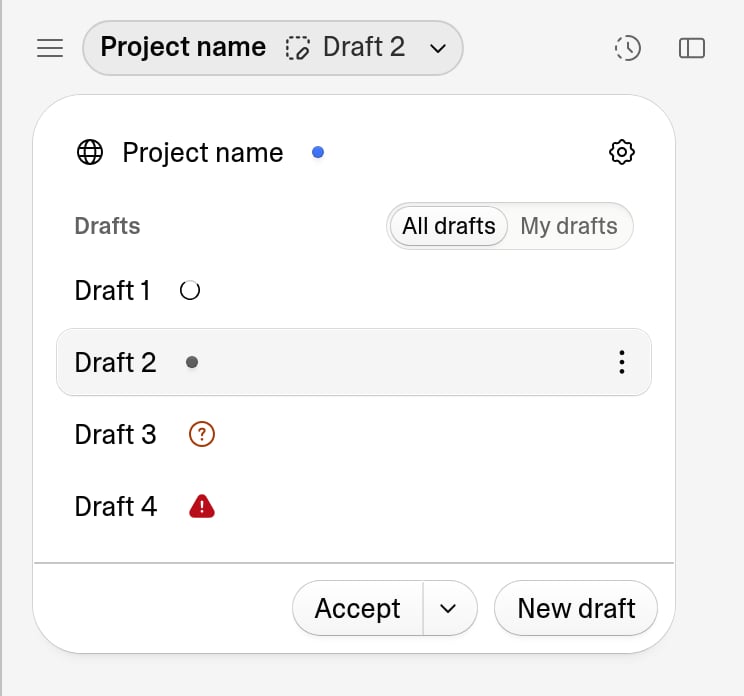
If a draft has no indicator, it doesn’t need your attention.
The top row, which shows your project’s name, has an indicator of its own. It tells you whether your project is published, and whether it has changes you haven’t published yet:
On a published project, accepting a draft turns that dot blue, because the draft’s edits are now waiting to be published. See Publish your project.
Update a draft with newer project changes
A draft starts as a copy of your project. After you create it, you or a teammate might make newer changes to the project. Those changes don’t appear in the draft automatically. When newer changes are available, the draft’s row in the switcher shows a gray dot labeled Updates available. Select Update to bring the newer project changes into the draft. You can update from the chevron next to the switcher’s Accept button or from the draft’s ⋮ menu. You can also ask Lovable to update the draft in its chat. If the newer project changes overlap with edits in the draft, Lovable adjusts the draft’s edits to work with the updated version. The update can take a few minutes, and Lovable may add a follow-up message to the draft’s chat. The update doesn’t use credits. You can update a draft while Lovable is working in the main version of your project. The draft brings in the edits your project has finished so far. You don’t need to update a draft before accepting it. If your project has newer changes, Lovable updates the draft first and then accepts it. To do both steps yourself, select Accept draft after updating in the update dialog.Delete a draft
To delete a draft, open its ⋮ menu, select Delete, and confirm. Deleting removes the draft and all of its edits. Your project stays unchanged, and the deleted draft can’t be restored.Change the order of your drafts
The switcher lists your drafts with the most recent activity first. To set your own order, press and hold a draft for a moment, then drag it where you want it. Lovable remembers that order for the project in the browser you’re using. You can’t reorder drafts while the My drafts filter is selected, because the list is showing only some of the project’s drafts. Select All drafts first.Use drafts with your team
Everyone with edit access to the project sees the same drafts. Each draft shows who’s currently working in it. If you open a draft that someone else is using, Lovable suggests creating your own draft so you can work separately. When someone else has created a draft in the project, the switcher’s Drafts heading shows two tabs: All drafts and My drafts. Select My drafts to narrow the list to the drafts you created. In a project where you’re the only person who has created a draft, the tabs don’t appear. The same tabs appear in the drafts list on your phone. When someone accepts a draft, its changes are added to the project for everyone. Any other open drafts then show the gray Updates available dot until you update them. If several drafts are accepted around the same time, Lovable processes them one at a time. When more than one draft is waiting, an Accepting drafts card appears above the project chat and shows the order. You can remove a waiting draft or drag drafts to change the order.Drafts share your app’s backend and data
A draft keeps your changes to the app separate, but it doesn’t have a backend of its own. Every draft uses your project’s built-in backend: the same database, the same files, and the same settings. If you add, edit, or delete information while testing in a draft, those changes are real, just as they are when you test your project directly. Deleting the draft doesn’t undo them. Backend work you ask for in a draft applies to your project in the same way, apart from the changes listed below. When an action is harder to undo, Lovable explains it in the draft’s chat first and asks you to confirm.Backend changes you make in the main version
A change to how that shared backend is configured reaches your published app immediately, so Lovable makes these changes only in the main version of your project:- Backend functions. You can edit a backend function’s code in a draft, but Lovable deploys it only from the main version. The change takes effect after you accept the draft.
- Sign-in methods, including social login providers such as Google and Apple.
- Secrets, the values your app uses to reach other services.
- File storage settings, such as whether a storage bucket is public.
- Enabling AI features for your app. See AI features for your app.
- Payments, including enabling payments and creating products and prices, whether you use the built-in payments or your own Stripe account. See Add payments to your app.
- Email sending, including your email domain, email templates, and enabling or disabling emails from your app. See Send branded emails from your own domain.
- Enabling the built-in backend, if your project doesn’t have it yet.
Add database tables and columns from a draft
Your app keeps its information in a database, organized into tables. A table of reviews, for example, has a column for the rating, one for the comment, and one for the product being reviewed. Every draft uses the same database as your project, so Lovable doesn’t add a table or a column while you work in a draft. It prepares the change and makes it when you accept the draft:- You ask for it in the draft’s chat. For example, “Add a reviews table with a rating, a comment, and the product it belongs to.”
- Lovable prepares the change and builds the pages that use it. The table doesn’t exist yet, so any page that reads or saves reviews shows an error in the draft’s preview. That error is expected, and it disappears when you accept the draft.
- You accept the draft. Lovable adds the table to your project’s database and describes what it added in your project’s main chat.
Work with drafts on your phone
You can create, switch between, and manage drafts from your phone. Open the drafts list in either of two ways:- Tap your project’s name at the top of the screen and select Drafts.
- Tap the button above the chat input, which shows Main or the name of the draft you’re in. It appears once the project has at least one draft.
Limitations
Keep these in mind while you work with drafts.- Drafts don’t support Git sync yet. A draft doesn’t appear as a branch in your connected repository, and its code reaches the repository only after you accept the draft.
- Some backend work has to happen in the main version of your project, including changes to your app’s sign-in methods, secrets, backend functions, payments, and email sending. See Backend changes you make in the main version.
Troubleshooting
If drafts aren’t working as expected, these are the most common causes.Accept or Update is grayed out
Accept or Update is grayed out
Hover over the button to see why it’s unavailable. The two actions become unavailable for different reasons.Accept is unavailable when the draft has no edits yet, when it’s already being accepted or waiting its turn to be accepted, and while the draft is being created or deleted.Update is unavailable when the draft is already up to date with your project, when an update is already running, while Lovable is working in the draft, and while the draft is being accepted or deleted.Wait for the current work to finish, then try again.If you drag a draft onto the top row, which shows your project’s name, and it can’t be accepted yet, the draft returns to its place in the list and Lovable shows you the same reason.
Update failed
Update failed
The draft couldn’t bring in your project’s newer edits.Select Update to try again. If it fails again, wait until Lovable finishes the work it’s doing in the draft, then retry.
This draft has been accepted
This draft has been accepted
You’re viewing a draft that was already accepted, usually after opening it from your project’s history. You can still read its chat and review its edits, but you can’t continue building in it, so the chat input is replaced by this message.Select View latest to return to the main version of your project, where the draft’s edits now live.
You're signed out of your app in a draft's preview
You're signed out of your app in a draft's preview
Each draft preview has its own web address, so your sign-in doesn’t always carry over. If your app has user accounts, sign in again inside the draft preview.The draft keeps you signed in while you build in it, and your account and its data are unaffected.
FAQ
Common questions about working with drafts.Does building in a draft affect my published app?
Does building in a draft affect my published app?
No. A draft’s edits stay in the draft until you accept it. Accepted edits are added to your project’s unpublished changes and reach your published app only when you publish.
Can I reopen a draft after accepting it?
Can I reopen a draft after accepting it?
You can reopen an accepted draft from your project’s history to read its chat and review its edits, but you can’t continue building in it.To continue the idea, create a new draft from the latest version of your project. To undo everything the accepted draft added, restore an earlier version from version history. You can’t revert individual edits from an accepted draft one by one.
Is there a limit on the number of drafts?
Is there a limit on the number of drafts?
No. You can create as many drafts as you need.
Who can work with drafts?
Who can work with drafts?
Anyone with edit access to the project can create, build in, update, accept, and delete drafts. People with view-only access can switch between drafts and view their previews, but draft actions are disabled for them. Drafts don’t appear in preview links.
Do drafts use extra credits?
Do drafts use extra credits?
No. Messages you send in a draft cost the same as messages in the main version of your project, and a draft you aren’t working in doesn’t use credits.Creating, updating, accepting, and deleting a draft don’t use credits, including an update where Lovable adjusts the draft’s edits to work with newer project changes, and an accept where Lovable updates the draft first.
Can I use drafts in a project with a database?
Can I use drafts in a project with a database?
Yes. A draft’s preview uses your project’s real data, so any data you add, edit, or delete while testing in a draft is changed for real. You can also ask for new tables and columns in a draft, and Lovable adds them to your database when you accept it. See Add database tables and columns from a draft.
Is a draft the same as a branch?
Is a draft the same as a branch?
Yes. Creating a draft forks your project, so the draft has a history of its own alongside your project’s. Accepting the draft merges it back, and updating it rebases it onto your project’s latest edits. The product calls those actions Accept and Update, and you don’t need any version-control experience to use them. See For readers who know version control for how each term maps.
Can I use drafts with a connected Git repository?
Can I use drafts with a connected Git repository?
Yes, but Git sync doesn’t support drafts directly yet. You can still work in drafts, and edits you accept sync to your default branch like any other project change.
Why did my draft disappear?
Why did my draft disappear?
Lovable removes a draft with no edits after 24 hours, so no work was lost. If you accepted the draft instead, you’ll find it in your project’s history.